Turning policy documents into payment rules, ten times faster.
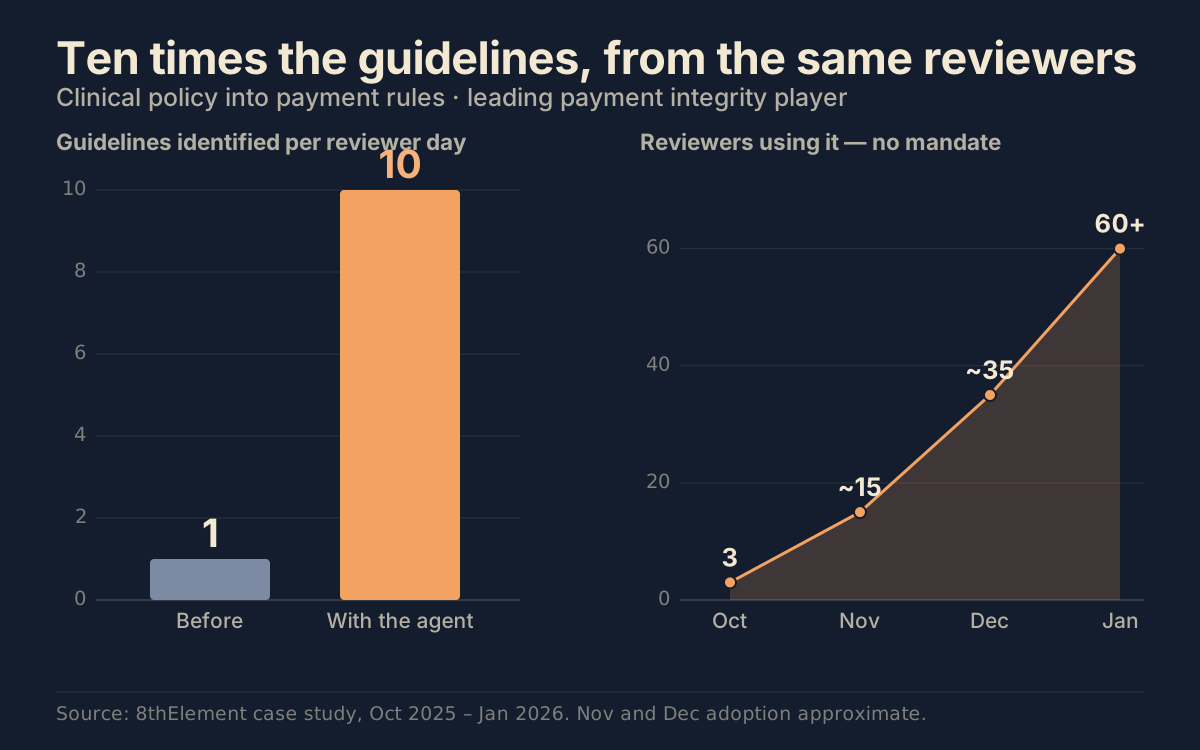
The content behind accurate claims decisions is created by clinicians reading long policy documents and identifying language that could become a denial criterion. It was one document, one reviewer, one day. It is now ten guidelines a reviewer day, with the judgment still human.
Why this queue costs what it costs.
The bottleneck was reading, not judging
A specialist would take a policy document of several hundred pages, read it, find the language that defines coverage or denial criteria, and draft a guideline for review and coding into a rule. Steps two and three consumed the day.
Every document in the queue is a rule not running
The backlog grew faster than the team could work it, and each unworked document represented contingent revenue sitting idle.
What the agent does, and where the human stays.
Read exhaustively
The agent ingests the document, identifies passages matching the language patterns that define clinical rules, and ranks candidates by confidence.
Cite everything
Each candidate is presented with its source passage, page and section, plus whether it duplicates an existing rule.
Change the reviewer's task
The reviewer moves from reading to reviewing: approve, edit or reject. A different cognitive task, and a much faster one.
Train on the decisions
Approvals, edits and rejections feed the next version. Accuracy compounds with use.
The constraints that make it deployable.
These are not aspirations. They are enforced in the build, checked by the eval suite and visible in the audit trail.
| 01 | Never writes a live rule. Every candidate is reviewed by a qualified person. |
| 02 | Every suggestion links to its source passage — no unsourced criteria. |
| 03 | Confidence thresholds set by the clinical lead; low confidence items are flagged, never hidden. |
| 04 | Low-confidence or contested candidates can be routed to a second reviewer. |
| 05 | Full version history on every guideline from candidate to active rule. |
What the sponsor sees every month.
The baseline is agreed with Finance before we start. These are the lines on the console — and what our outcome fee is read from.
Guidelines identified per reviewer day
Reviewer acceptance rate
Days from policy publication to active rule
Contingent revenue unlocked
Adoption: active reviewers
12 weeks to first production outcome
Blueprint and eval scaffolding by week 2, shadow mode by week 8, approve mode with a measured result by week 12 — then autonomy expands on evidence.
How AIM sequences it →