Prior authorisation, without making the nurse do the reading.
Most of a prior auth case's cycle time is spent locating and reading clinical evidence. The determination itself takes minutes. We put an agent on the reading and leave the determination exactly where regulators expect it.
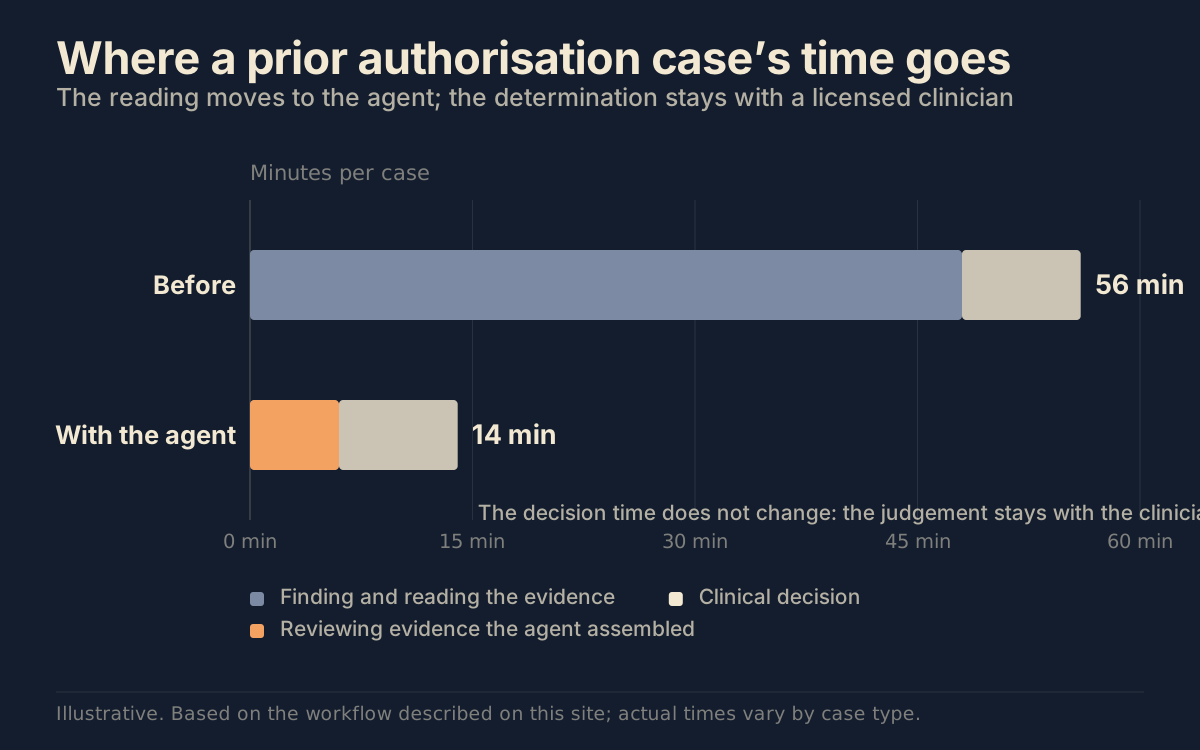
Why this queue costs what it costs.
Where the time actually goes
A UM nurse opens a case and starts hunting: the request, the attachments, the member's history, the applicable medical policy. Reading and assembling can take the better part of an hour. The clinical judgment takes a fraction of that.
Why more headcount doesn't fix it
Volume rises with membership and with every new policy. Turnaround SLAs are set per state and don't move. Hiring your way out means hiring licensed clinicians to do document retrieval.
What the agent does, and where the human stays.
Retrieve and match
The agent pulls the request and attachments, identifies the applicable medical policy, and extracts the supporting clinical facts with a citation for each.
Recommend, never decide
It produces an evidence summary and a recommended determination. Cases that clearly meet criteria can be auto-routed for approval; anything adverse goes to a licensed clinician, always.
Request what's missing
Where the file is incomplete, it drafts the missing-information request rather than sitting in a queue.
Learn from the override
Every nurse or medical director decision — accept, edit, reject — is captured, analysed for patterns and fed back into thresholds.
The constraints that make it deployable.
These are not aspirations. They are enforced in the build, checked by the eval suite and visible in the audit trail.
| 01 | Never issues a denial. Adverse determinations require a licensed clinician, without exception. |
| 02 | Turnaround SLAs tracked per state rule, with alerting before a breach. |
| 03 | Full audit trail per case: inputs, model, evidence, recommendation, approver. |
| 04 | PHI stays in your environment; Argos pins the use case to approved models and regions. |
| 05 | Fairness monitoring across member groups on approval and escalation rates. |
What the sponsor sees every month.
The baseline is agreed with Finance before we start. These are the lines on the console — and what our outcome fee is read from.
Turnaround time per case
Auto approve rate on clearly meeting cases
Appeal overturn rate
Cost per approved determination
Nurse hours returned to clinical work
12 weeks to first production outcome
Blueprint and eval scaffolding by week 2, shadow mode by week 8, approve mode with a measured result by week 12 — then autonomy expands on evidence.
How AIM sequences it →