Voyager — coding agents make an engineer faster. Voyager makes a programme faster.
Programmes are slowed by unsigned specs, missing tests, integration surprises and a release process nobody trusts — not by typing speed. Voyager applies agents across the whole lifecycle and puts human gates where regulated enterprises need them.
Seven stages. Four human gates. One eval suite that never sleeps.
Every stage has an agent doing the volume work and a person doing the signing. The gates aren't ceremony — nothing moves without the signature, and the signature is logged for audit.
Intent
Sponsor states the outcome and owns the KPI.
Spec
Blueprint, data contracts, first evals. Signed.
Plan
Bounded tickets with test expectations and token budgets.
Build
Agents code and test; engineers review and merge.
Evaluate
Behaviour, safety and cost evals in CI. Regressions block.
Ship
Risk owner expands autonomy, stage by stage.
Observe
Production traces become new eval cases.
Built for places where “move fast” has to survive an audit.
Evals before code
The eval suite is drafted with the spec, including failure and abuse cases. Code is written to pass evals, not the other way round.
Bounded tickets
Build agents work in scopes small enough for a human to review properly. No thousand-line pull requests.
Cost is a test
A change that doubles inference cost per transaction fails the gate even if accuracy passes. Argos supplies the number.
Signatures are logged
Who signed the spec, who merged, who expanded autonomy and why — read straight into the board pack.
Legacy-aware
The Codebase Assessor maps the old system first. Agents wrap it safely rather than pretending it isn't there.
Yours afterwards
Specs, evals, pipelines and patterns are handed over. Your engineers run Voyager after we leave.
What a Voyager pod reports every sprint.
- Spec → shadow: days from signed spec to first shadow-mode run
- Cycle time: ticket open to merged, with review time separated out
- Defect escape rate: issues found in production per release
- Cost per merged PR: tokens and compute, straight from Argos
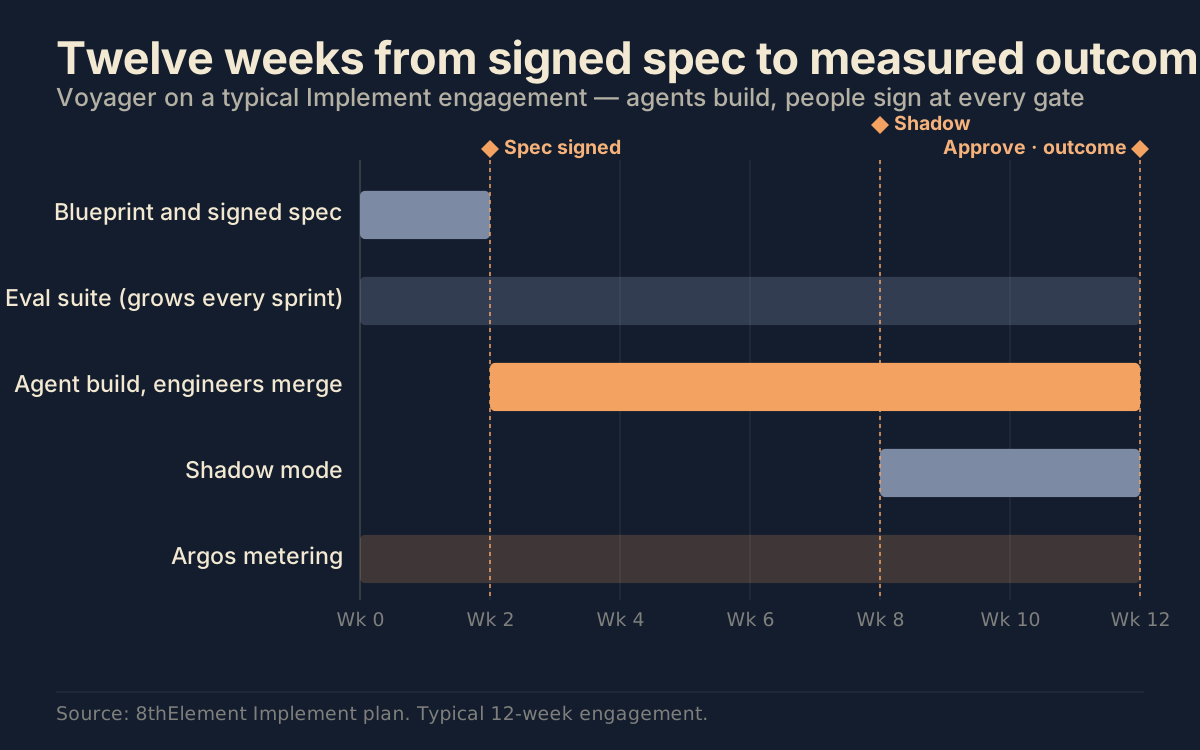
On the clinical content engagement: twelve weeks from start to first production version, then shadow to approve mode as reviewer acceptance climbed.
Read that case study →