AIM: how an engagement runs, phase by phase.
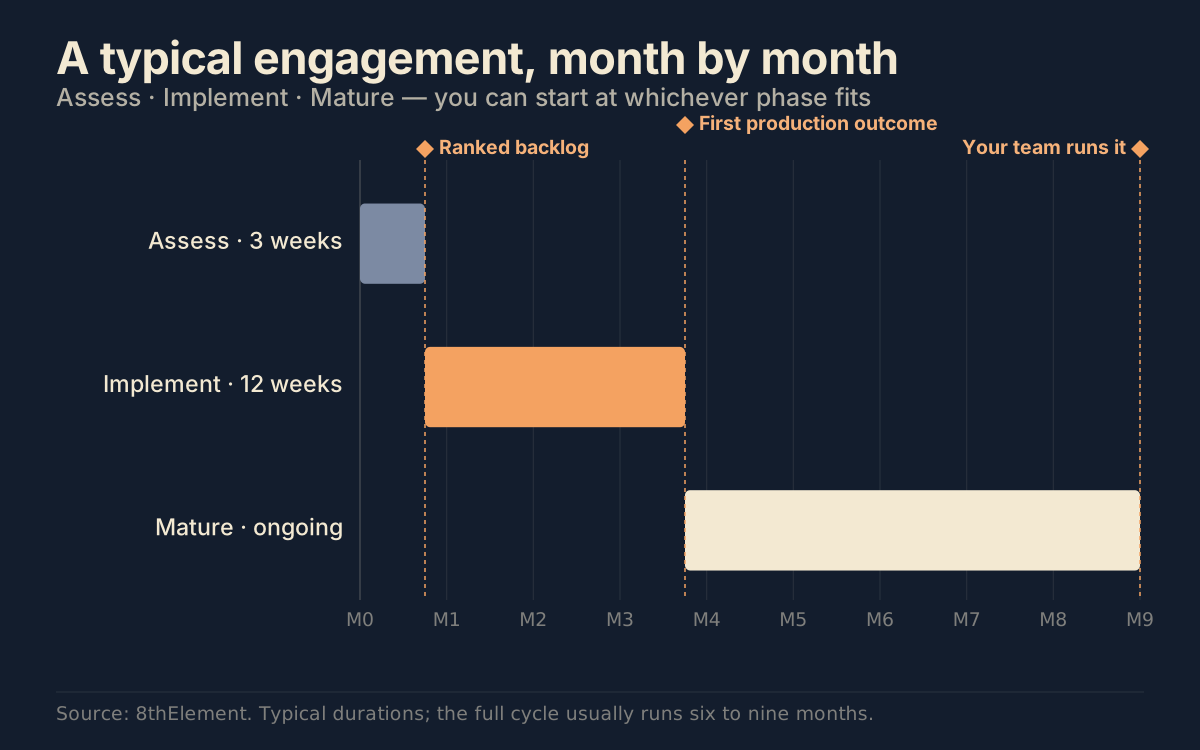
Each phase ends where the next one can start: an assessment you can act on, a use case running in production, then the routine handled and the exceptions escalated. Most clients run the full cycle in six to nine months, and you can start at whichever phase fits.
Assess
Where are we, honestly?
- Scanning agents deploy read only in your estate
- Evidence based maturity score per business unit
- Full inventory: owner, KPI, run cost, status
- Use cases ranked on value, readiness, exposure
- Argos spend baseline, signed by Finance
Gate: a ranked backlog where every use case has a sponsor, a baseline and a target.
Implement
Can we ship one outcome and prove the pattern?
- Spec signed before a line of code
- Voyager agents build; engineers review every merge
- Shadow → approve → bounded autonomy on evidence
- Reviewers trained and in the loop from week one
- Pattern captured for the next business unit
Gate: an agent in approve mode with a measured business outcome.
Mature
Can it run better with fewer hands on it?
- Tiered autonomous maintenance: L1 resolve, L2 triage, L3 forensics
- Drift, quality and fairness monitored continuously
- Argos routing and deviation detection portfolio-wide
- Board ready governance pack from live evidence
- Pattern library so the next build starts ahead
Graduation: your team runs it. We move from running to advising.
Most enterprises think they're Level 2.
The evidence usually says otherwise. Assess scores each business unit against the model, and the score decides which phase starts first and what a pod looks like.
“We are experimenting with AI.”
Opportunistic proofs of concept, siloed data, limited KPI linkage, high cost and low realised value. Most use cases never leave PoC, and nobody can say what AI costs to run.
“We are deploying AI.”
Productionised models and MLOps, clear KPI alignment, value trapped in silos. Moderate reuse. Costs known per project, never per outcome.
“AI runs our business.”
Self-learning loops, agentic execution, tied to revenue and risk at CXO level. High decision automation and a cost per outcome that trends down every quarter.
What changes between phases.
Engagements can start at any phase. Most clients run the full cycle over six to nine months.
| Assess | Implement | Mature | |
|---|---|---|---|
| Question answered | Where are we, honestly? | Can we ship one outcome? | Can it run with fewer hands? |
| Duration | 3 weeks | 12 weeks to first outcome | Ongoing, for as long as it earns its place |
| Who is in the pod | Assessment lead, domain SME, data lead + scanning agents | Architect, engineers, operators + Voyager build and eval agents | SRE, change lead, FinOps analyst + Argos and maintenance agents |
| Gate to next phase | Ranked backlog with owners and baselines | Approve mode agent with measured outcome | Outcome, adoption and cost per outcome on the console |
| Agents involved | 6 Assess agents | 22 Implement agents | 9 Mature agents |
| How we are paid | Fixed fee, credited against Implement | Base plus share of the outcome | Share of outcome and cost reduction |
You do not have to run all three. Most clients start where their gap is and complete the full cycle in six to nine months. If the prioritisation work is already done, we start at Implement.