Ship AI systems in twelve weeks that survive an audit.
Coding agents make an individual engineer faster. They don't make a programme faster, because programmes are slowed by unsigned specs, missing tests, integration surprises and a release process nobody trusts. This is agents applied to the whole lifecycle, with human gates where regulated enterprises need them.
Why this queue costs what it costs.
Speed at the keyboard isn't the constraint
Teams adopt coding assistants and are surprised when delivery dates don't move. The bottleneck sits in specification, review, integration and release confidence.
Regulated delivery has extra gates for good reason
In healthcare and financial services, an unexplained change in a production decision system is a finding. Velocity that can't evidence itself is a liability.
What the agent does, and where the human stays.
Sign the spec first
Intent becomes a blueprint, data contracts, acceptance criteria and an initial eval suite — including failure and abuse cases. The sponsor signs; nothing is built from an unsigned spec.
Build in bounded scopes
Build agents write code and tests and open pull requests with explanations, in scopes small enough for a human to review properly.
Gate every change
Behaviour, safety and cost evals run in CI. A change that regresses any of the three blocks.
Roll out in stages
Shadow, then approve, then bounded autonomy — each expansion signed by the risk owner and logged.
The constraints that make it deployable.
These are not aspirations. They are enforced in the build, checked by the eval suite and visible in the audit trail.
| 01 | No direct pushes to protected branches; engineers review and merge everything. |
| 02 | Secrets never appear in prompts or logs; dependency and licence scanning on every PR. |
| 03 | Eval gates cannot be bypassed without a named approver and a recorded reason. |
| 04 | Cost per transaction is a test — doubling it fails the gate even when accuracy passes. |
| 05 | Every human signature logged and readable straight into the governance pack. |
What the sponsor sees every month.
The baseline is agreed with Finance before we start. These are the lines on the console — and what our outcome fee is read from.
Days from signed spec to first shadow run
Cycle time, with review time separated
Defect escape rate per release
Cost per merged pull request
Rework after build
12 weeks to first production outcome
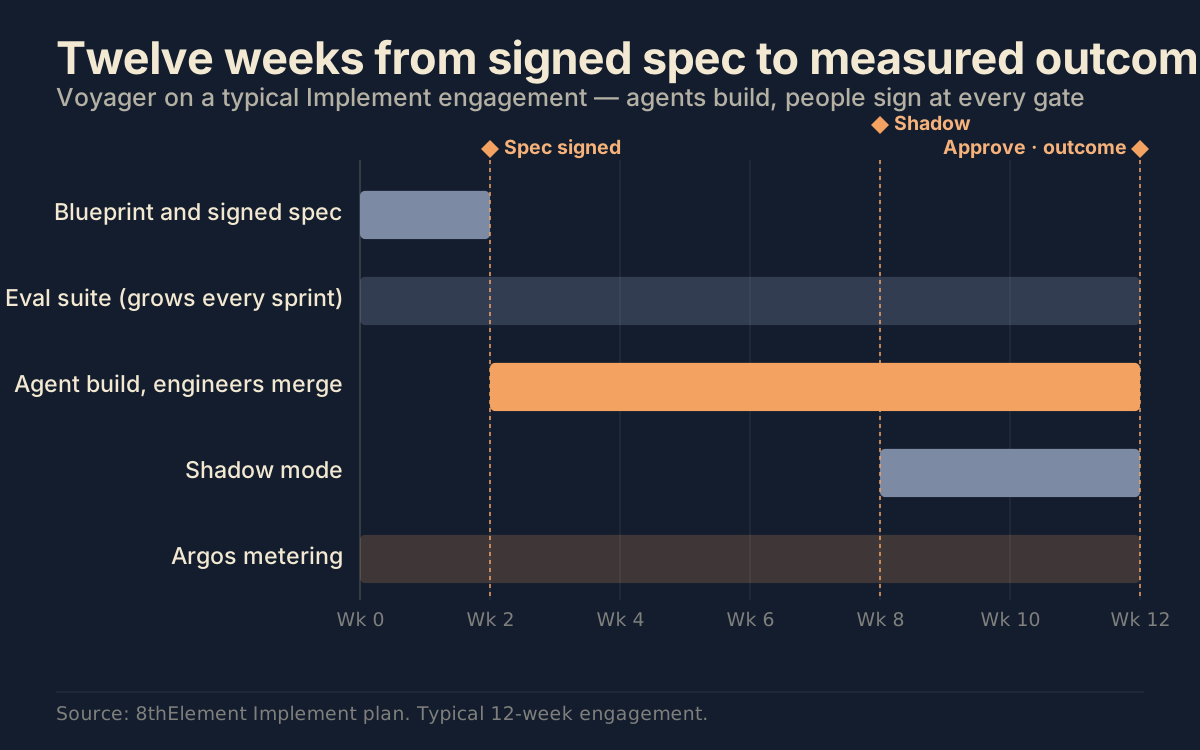
Blueprint and eval scaffolding by week 2, shadow mode by week 8, approve mode with a measured result by week 12 — then autonomy expands on evidence.
How AIM sequences it →