Claim editing, measured on what stayed paid.
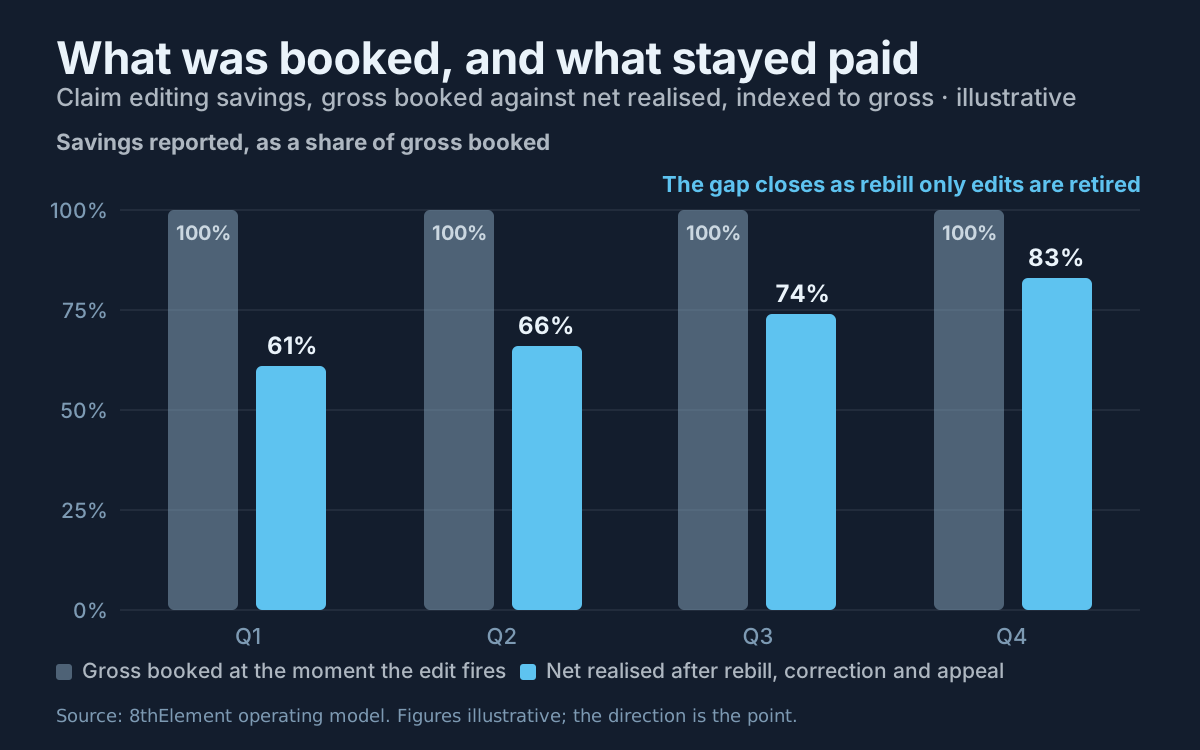
Most editing programmes are paid on avoidance: an edit fires, a line is denied, and the dollar is booked as savings. A denied line is not always a saved dollar. We follow every edited line through rebill, correction and appeal to the number that actually stayed changed, and we build the economics around that.
A reconciliation problem that comes from how the industry pays.
An edit fires, a dollar is denied or reduced, and that dollar becomes savings. Fees are calculated on it, often at the moment the edit fires. Then the provider corrects and rebills. A line denied for a coding issue comes back days later with the right modifier and gets paid, sometimes at nearly the original amount. A claim is voided and replaced. An appeal overturns the decision. What was booked as savings was really a delay, a recode or a reversal.
Matching the corrected claim back to the original edit is hard. Corrections arrive under new claim numbers, outside the reporting window, or through a different channel. So the reported number stays gross, fees stay tied to it, and finance spends every quarter working out what was actually kept.
Every edited line, followed to its net outcome.
Link the correction to the decision
Corrected claims, replacements and appeals are matched back to the original edit automatically: by member, provider, service, dates and amounts, across claim numbers, channels and reporting windows. The spreadsheet retires.
Follow the line, not the denial
Each edited line carries its own history: denied, rebilled, recoded, paid, reversed. The net change in payment is the number, and the time it stayed changed is part of it.
Report what a CFO can defend
Gross avoided and net realised, side by side, by edit, by vendor and by provider. Edits that only generate rebills are visible, and so are the ones that changed billing behaviour for good.
Align the economics
With net outcomes measured, compensation can follow sustained accuracy rather than first pass denials. Edits that create churn get retired. Edits that change behaviour get rewarded. Provider abrasion falls.
Payer, vendor and provider, looking at the same history.
The same edited line, the same corrections, the same net result, visible to everyone who had a hand in it. Disputes get shorter when nobody is reconciling from a different spreadsheet.
A savings number finance signs
Net realised, reconciled automatically, with the gross figure beside it so the gap is never a surprise at quarter end.
Credit for edits that hold
Compensation that follows sustained accuracy rewards the edits that changed behaviour, not the ones that generated churn.
Fewer denials that come back paid
Edits that only trigger rebills are retired, which means less abrasion and fewer corrected claims in the queue.
How does your savings reporting handle rebills and corrected claims today?
If the answer involves a spreadsheet and a quarter end scramble, that is the queue we would start with. The avoidance model made sense when editing was simpler. There is a better way, and it takes the payer, the vendor and the provider working from one record.