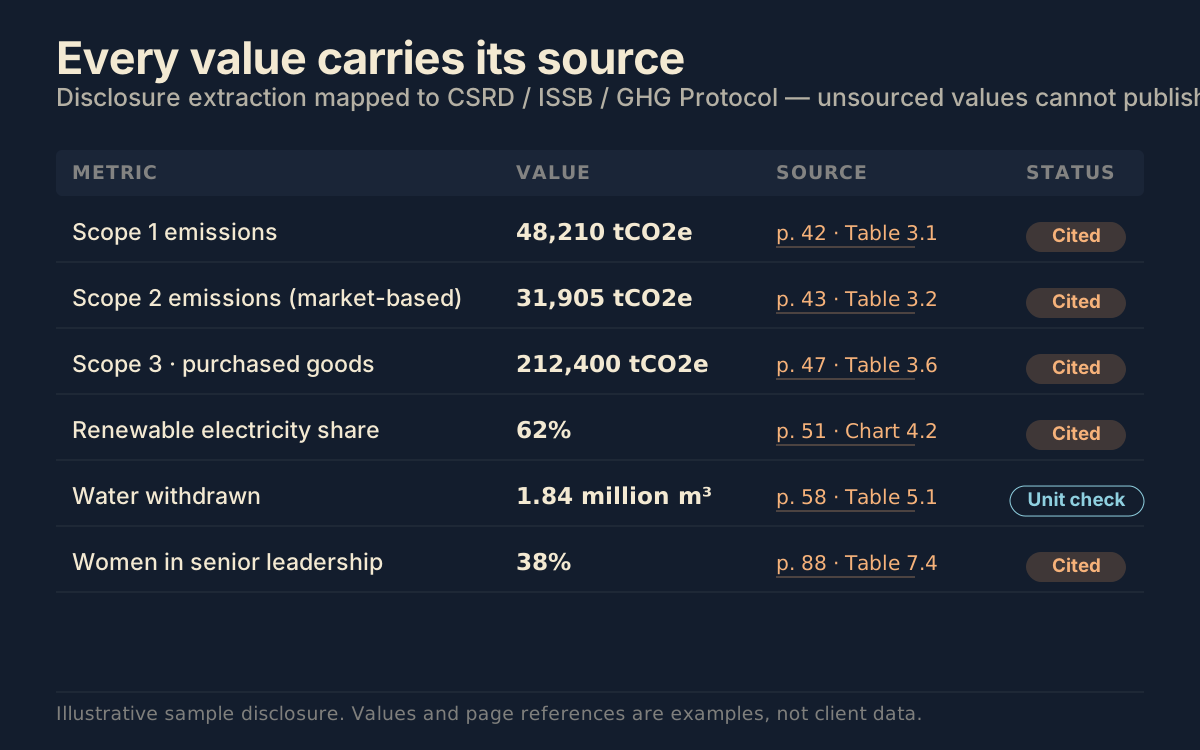
Every ESG number traceable to the page it came from.
Sustainability reporting is a reading problem at industrial scale — thousands of disclosures in a dozen formats and languages, mapped to frameworks that keep changing, with assurance providers asking where each number came from. Agents are good at exactly this, provided every value keeps its provenance.
Why this queue costs what it costs.
Coverage was a headcount problem
Analysts read reports, transcribed values and mapped them to taxonomies by hand. Coverage was limited by how many analysts there were.
Provenance was an argument
When a client or assurance provider challenged a value, finding the source page took longer than the original extraction. Limited assurance is the standard under CSRD, and it tests traceability — that gap becomes untenable.
What the agent does, and where the human stays.
Ingest anything
PDFs, spreadsheets, questionnaires and web disclosures, in multiple languages.
Map through versioned rules
Each data point mapped to CSRD/ESRS, ISSB, GRI and GHG Protocol through rules that are versioned and auditable, so a regulation change is a rule change rather than a re-read.
Attach the evidence
Every value carries the page, table and cell it came from, plus the mapping rule that placed it and the analyst who approved it.
Check before accepting
Unit and boundary validation, year on year and peer comparison. Anything unusual routes to an analyst rather than into the dataset.
The constraints that make it deployable.
These are not aspirations. They are enforced in the build, checked by the eval suite and visible in the audit trail.
| 01 | Unsourced values cannot be published or actioned — the rule the whole architecture rests on. |
| 02 | Analyst review required on any year on year movement above threshold. |
| 03 | Mapping rule library versioned and dated, with change history. |
| 04 | Restatements flagged and tracked rather than silently overwritten. |
| 05 | Assurance-ready workpapers generated automatically. |
What the sponsor sees every month.
The baseline is agreed with Finance before we start. These are the lines on the console — and what our outcome fee is read from.
Data points per analyst-day
Share of published values with provenance
Restatement rate
Coverage by framework
Time to answer an assurance challenge
12 weeks to first production outcome
Blueprint and eval scaffolding by week 2, shadow mode by week 8, approve mode with a measured result by week 12 — then autonomy expands on evidence.
How AIM sequences it →